 0474 011 120
 info@budgettreeremoval.com.au


 0474 011 120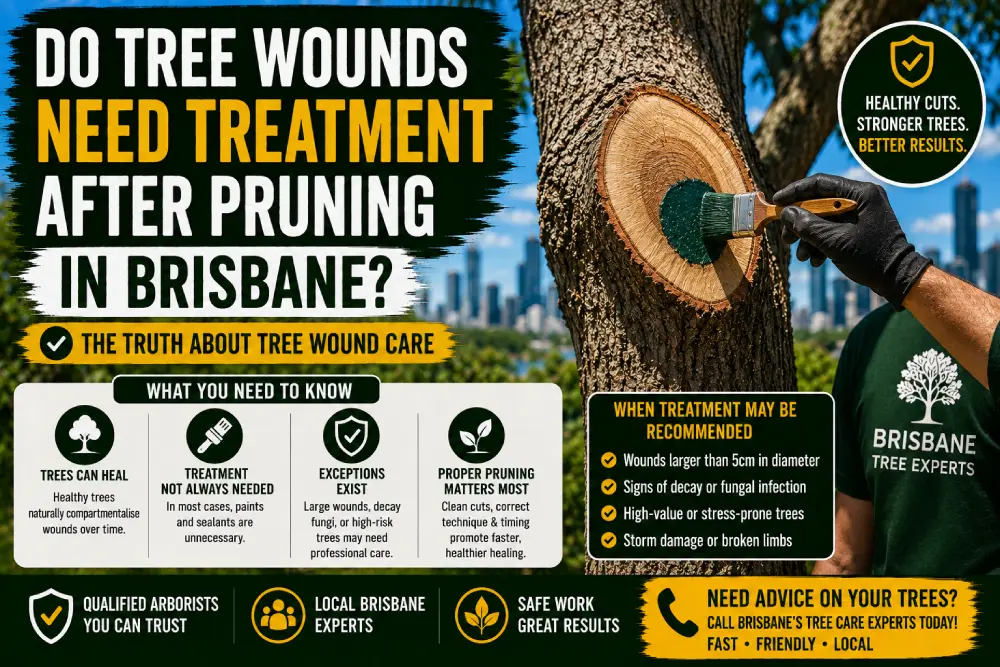
Wound sealants, paints, and pruning compounds — are they helpful or harmful? The current arboricultural view.
The old advice was wrong
For decades, the standard recommendation was to paint pruning wounds with a wound sealant or bitumen-based paint. This is now considered counterproductive by most arboriculturalists. Wound sealants seal in moisture and prevent the tree's natural wound response — the formation of a callus ring that grows inward over the wound.
What trees actually do
Trees don't heal wounds the way animals do — they don't regenerate tissue. Instead, they compartmentalise decay by forming chemical and physical barriers around the wound zone, then grow callus tissue over the wound surface. This process is best done in open air.
When sealant might help
The limited exception is for certain species susceptible to specific pathogens that enter through fresh pruning wounds — some oak species in areas with oak wilt, for example. In Brisbane, this is rarely relevant for common residential species.
The real answer
The best "treatment" for a pruning wound is a correct cut at the branch collar. A collar cut initiates the fastest, most complete wound response. A stub cut or flush cut damages the wound response zone and no amount of sealant compensates for that.
Need a tree arborist in Brisbane? Call 0474 011 120 or fill in our quote form. Same-day response, Mon–Sat 7am–6pm.