 0474 011 120
 info@budgettreeremoval.com.au


Palm Tree Removal Brisbane
Cocos, bangalow, alexandra, foxtail, date and golden cane palms removed whole or sectioned — even over a pool. Send a photo and get a quote the same day.
- Several palms on one visit cost less per palm
- Sectioned on ropes next to houses, pools and fences
- Fronds, seed heads and trunk taken away, site raked clean
- AQF Level 5, $20M insured, council check included
 0474 011 120Answered 24 hours
Get a price for your tree
Send us a photo and your suburb. Most quotes go back the same day, and there's no obligation.
Average starting prices
Height and access do most of the work in a palm quote. With no canopy to deal with, palms are often cheaper than a hardwood of the same height.
Send a photo for a price
Most backyard cocos and bangalows
Height, access and fronds set the figure
Often needs machinery
Cut out and removed
Added to any of the above
Cheapest: a palm with clear ground around it, felled in one piece. Dearest: a tall cocos wedged between a pool fence and the house, cut and lowered in sections. Same height, three times the labour.
Why so many cocos palms are coming out
The cocos palm (Syagrus romanzoffiana) is the one causing the most grief in Brisbane. Many were planted in the seventies and eighties and have grown far taller than expected.
Fruit drop
Fruit falls, ferments, stains concrete and gets walked through the house.
Flying foxes
They feed on the fruit — noise and mess at night all summer.
Weed spread
Seedlings crowd out natives in creeks and bushland. Widely treated as an environmental weed in SEQ.
Falling seed heads
Heavy fronds and whole seed heads drop over driveways and play areas.
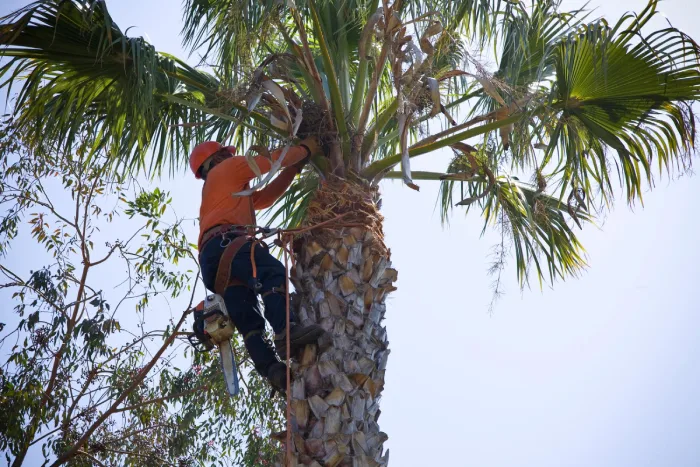
Whole or sectioned — we pick the safe option
Hardwoods are dismantled limb by limb. Palms have no limbs, so there are only two real options.
Felling whole
The trunk is cut at the base and dropped in one piece. Needs a clear drop zone at least as long as the palm is tall.
Sectioning
A climber spikes up the trunk, removes the crown, then cuts the trunk down in metre lengths, lowering each on a rope. The only safe option over a roof, pool, fence or garden.
Why spiking is fine on palms
You can't spike a hardwood you're keeping — the wounds let decay in. On a palm that's coming out, spiking is standard. It's the opposite of a tree lopping job, where the tree stays.
When machinery is needed
Very large date palms, or anything over a structure with no rope path. We tell you upfront — it changes the price and the street needs organising beforehand.
Palms are usually simpler than removing a hardwood of the same height — no branches to rig, no canopy to bring down in pieces.
Send a photo, get a price today
Include the house or a car in the shot for scale, plus your suburb.
Palms we remove, and what changes with each
🌴Cocos palm
Tall, fast, heavy fruiter — the default Brisbane job. The fibrous trunk holds water, so sections are heavier than they look.
🌿Bangalow palm
Native, slender, often in clumps. Lighter than cocos; shaded ones grow very tall and thin, which changes the climb.
🌿Alexandra palm
Like bangalow with a more swollen base. Common in the eastern suburbs. Straightforward removal.
🦊Foxtail palm
Thick trunk, dense crown, heavy for its height. Often sectioned rather than felled because of where it's planted.
🌵Date palm (incl. Canary Island)
The hard one. Enormous mass, spines on every frond, a root ball up to 1.5m across. Usually needs machinery.
🎋Golden cane palm
A spreading clump, not a single trunk. The clump and base must come out or it grows straight back.
🔥Washingtonia (cotton palm)
Very tall, often with a skirt of dead fronds that's a fire risk and rat habitat — the reason many come out.
✂️Keeping the palm?
Annual seed-head and dead-frond removal stops fruit, flying foxes and seedlings for a fraction of a removal.
❌Can't be shortened
Palms grow from one point at the top. Cut it out and the palm dies — if it's too tall, removal is the only option.
What happens on removal day
Check the drop zone
We decide fell or section on the spot — ground changes after rain.
Fronds first
Fronds and seed heads come off and are chipped straight away.
Trunk down
In one piece or in sections. Cocos trunk goes out on the truck in lengths.
Proper clean-up
Fibre and small fruit raked and blown down before we leave.
Grind the stump on the same visit
- Palm stumps are fibrous — a cocos stump goes soft in 2–3 years, not ten
- But they're dense and wet, so they still need a proper grinder
- Mature date palms have a solid root mass — full excavation is a genuine dig
- Cheapest done with the removal, while the machine is already there
Details: palm stumps and stump grinding.
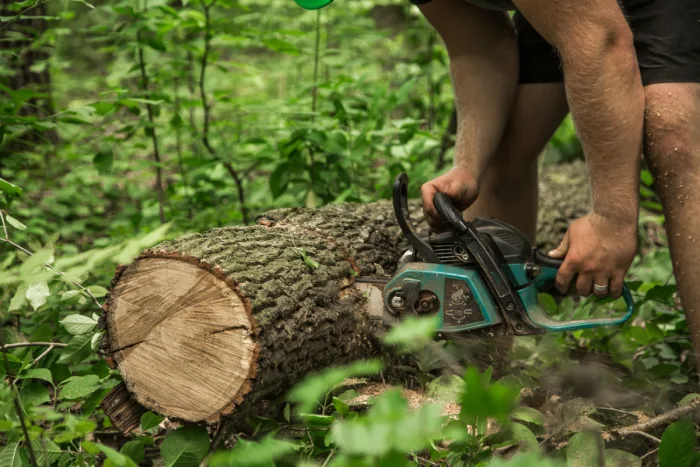
Palm work is routine for us
Climbing a palm is a specific skill — no limbs to work off, the trunk is the only anchor, and spiking technique keeps the climber attached.
We do palms constantly
Mostly through the eastern suburbs, where the seventies plantings are thickest.
$20M insured
Many palm jobs are two metres from a neighbour's car. Certificate of Currency on request.
Council check included
Most palms need no approval. We check VPOs and overlays with the quote, before booking.
Palm removal across Brisbane
Eastern suburbs
Bulimba, Hawthorne, Balmoral, Morningside, Cannon Hill, Coorparoo and East Brisbane — large cocos and alexandra palms from the seventies and eighties, now around fifteen metres in yards never designed for them. These usually need careful sectioning.
Northside
Carseldine, Fitzgibbon, Taigum and Bracken Ridge — newer plantings, so more foxtails and golden cane clumps, and more of them per property.
Common questions
Every palm is different, so these are average starting prices, not fixed prices. Medium palms of 3 to 7 metres start from $200 and tall palms of 7 metres and above from $450, depending on height, condition, access and how many fronds need clearing. Small palms are quoted from a photo. Several palms on one visit are much cheaper per palm.
No. Palms grow from one point at the top of the trunk. Remove that and the palm dies. Height reduction isn't possible on a palm, which is different to how hardwoods work.
Usually not. Most ornamental palms including cocos aren't protected. If your property carries a Vegetation Protection Order or sits in a protection overlay it's worth checking, and we do that check as part of the quote.
Fruit drop, flying foxes at night, staining on concrete, seedlings spreading into bushland, and falling seed heads. Cocos is widely treated as an environmental weed in South East Queensland, which is why so many are coming out.
Yes. Cutting the seed heads off before they ripen, once a year, deals with the fruit, the flying foxes and the seedlings. It costs a fraction of a removal and it's the right call if you like the palm.
A straightforward fell is under an hour. A tall cocos that has to be sectioned over a pool takes half a day. A large date palm needing machinery can take a full day.
Fronds and seed heads get chipped. Trunk sections go out on the truck, because palm trunk doesn't chip cleanly. Everything leaves the site unless you want the mulch.
Yes, and it's cheapest done at the same visit. Palm stumps are fibrous and rot faster than hardwood, but they're dense and wet so they still take a proper machine.
Yes. That's what sectioning is for. The climber takes it down in metre lengths on a rope rather than dropping anything. It costs more than a straight fell but there's no risk to the structure.
Much harder. Canary Island date palms in particular have enormous mass, spines at the base of every frond, and a root ball that often needs machinery. They're the most expensive palm to remove by a wide margin.
Yes. Golden canes send up new stems from the base, so cutting them at ground level doesn't work. The clump has to come out, or it regrows within a season.
Yes. Bulimba, Hawthorne, Balmoral, Morningside, Cannon Hill, Murarrie, Norman Park, Coorparoo and East Brisbane are all regular territory, and those older gardens are where most of the big cocos palms are.
Other Tree Services We Offer
Get a quote
Call 0474 011 120 or send a photo through the form. Most palm quotes come back the same day.