 0474 011 120
 info@budgettreeremoval.com.au

Tree lopping Brisbane, done the way it should be
Crown reduction, thinning, deadwooding and Tree Lopping Brisbane by AQF Level 5 arborists, with all cuts carried out to AS 4373 standards rather than topping. Free same-day quotes across Brisbane’s north and east.
 0474 011 120
What people mean when they ask for lopping
Most people who ring us asking for tree lopping want one of three outcomes. The tree is too close to the roof. It has grown into the powerlines. Or it drops so much debris in the pool that nobody wants to swim in it any more.
All of those are fixable. What we do about them is usually not lopping in the strict sense, and it's worth explaining why before you book anyone.
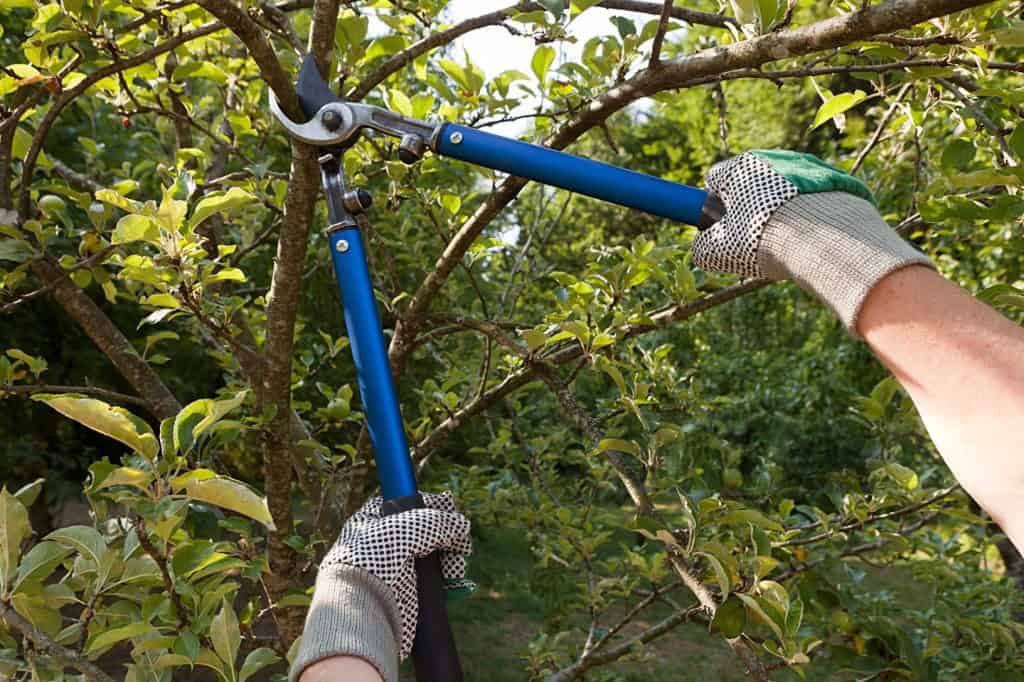
Lopping means cutting limbs back to stubs with little regard for the tree’s natural growth points. It was standard practice in Australia for decades, but it is now discouraged under AS 4373, the Australian Standard for pruning amenity trees. A topped tree can respond with fast, weakly attached regrowth that is more prone to failure during severe weather. The result can be poorer tree structure and the need for repeat work within a few years. This is why professional tree lopping Brisbane services should focus on appropriate pruning techniques rather than indiscriminate topping.
So when someone books us for lopping, we quote the job that actually solves the problem. Sometimes that's a crown reduction. Sometimes it's clearance pruning. Occasionally the honest answer is that the tree needs to come out entirely, and we'll say so rather than take money for a haircut that won't help.
What tree lopping costs in Brisbane
Pricing comes down to height, access and what has to happen to the debris. Here's the range we quote inside, so you know whether you're in the right ballpark before we come out.
| Job | Typical range |
|---|---|
| Small tree under 5m, easy access | from $199 |
| Medium tree, crown reduction or clearance | $300 to $800 |
| Large tree, crown reduction | $800 to $2,000+ |
| Deadwooding a mature gum or fig | quoted on site |
| Clearance pruning off a roof or fence | quoted on site |
| Powerline clearance work | quoted on site |
| Large or difficult trees over 15m | quoted on site |
Those bands are the same ones we publish on our tree removal cost page. Three things push a quote up more than anything else. Access is the big one. If we can get a chipper truck to the base of the tree, the job is straightforward. If everything has to come through a 900mm side gate by hand, the same tree takes twice as long.
The second is proximity to a target. A limb hanging over open lawn can be cut and dropped. The same limb over a colorbond roof, a pool fence or a neighbour's shed has to be rigged, lowered on ropes and controlled the whole way down.
The third is what happens to the waste. Every quote we give includes chipping and removal unless you tell us you want the mulch left on site, which plenty of people do for garden beds. If the tree is coming out altogether rather than being cut back, the pricing on our full tree removal page is the one to read, and you'll usually want stump grinding quoted at the same time.
Crown reduction, thinning, deadwooding and clearance
These four get used interchangeably by customers and they mean different things. Getting the right one is most of the value an arborist adds.
Crown reduction
The whole canopy comes down in height and spread, with every cut made back to a lateral branch big enough to take over as the new leader. The tree keeps its shape. It just gets smaller. This is what most people picture when they say lopping, and it's the correct version of it. If that's the job you want, our crown reduction page goes into the technique in more detail.
Reduction has limits. Take more than about a quarter of the live canopy off a mature tree in one go and you stress it badly. If someone quotes you to halve a big gum in a single visit, get a second opinion.
Crown thinning
Selected branches come out from inside the canopy so wind passes through instead of pushing against it. Height and spread stay the same. This is the right call for a tree that catches too much wind in a storm, or for letting light back onto a lawn that's gone patchy.
Deadwooding
Dead limbs get removed and nothing living is touched. Mature eucalypts shed deadwood constantly and it's the single most common cause of the branch that lands on a car. If you have a big gum over a driveway and you've never had it deadwooded, that's the job to book.
Clearance pruning
Cutting back to create a set distance from something. A roof, a driveway, a boundary fence, a powerline. Straightforward work, but the clearance distance matters and so does where the cuts land.

Powerlines and what you're allowed to do yourself
If the tree is anywhere near a powerline, this stops being a gardening question.
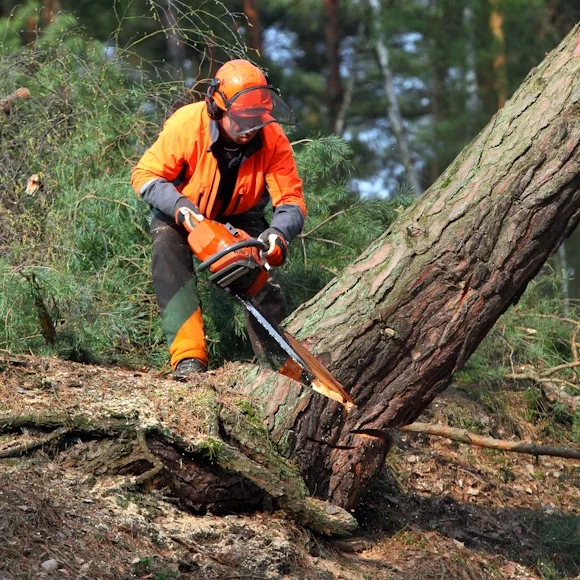
In Queensland, work close to live electrical infrastructure is restricted to accredited vegetation workers. Homeowners and general trades have to keep clear by the distance Energex publishes, and doing otherwise is both illegal and a genuinely good way to be killed. Energex maintains the clearance around its own network in some situations and not in others, depending on whether the line is a service line running to your house or part of the wider network.
Ring us and we'll tell you which category you're in. If it's an Energex responsibility we'll say so and you won't be charged for a job the network is obliged to do.
Council permits and protected trees
Brisbane City Council protects some vegetation under the Natural Assets Local Law and applies Vegetation Protection Orders to individual trees and stands. Pruning a protected tree without approval carries a fine.
Most standard suburban trees aren't covered, and routine pruning that stays under the threshold usually doesn't need anything. But we check VPO status on every quote before a saw comes out, and if a permit is needed we'll help you put the application together. Council permits and VPOs are covered in more detail on their own page.
When lopping isn't the answer
Some trees are past pruning. Being straight with people about that is part of the job.
If the trunk has a cavity you can put your arm into, if there are fruiting bodies of decay fungi at the base, if the tree has lifted on one side after heavy rain, or if a major limb has already failed, you're looking at a structural problem that pruning doesn't fix. In those cases we'll quote full tree removal instead and tell you why. If a limb has already come down, that's an emergency tree removal call rather than a pruning booking.
The reverse happens too. Plenty of people ring wanting a tree gone because it drops leaves, and once we've looked at it a thinning and a deadwood does the job for a third of the price. We'll tell you that as well. It's the same reason we wrote up the difference between an arborist and a tree lopper — the qualification is what decides which of those two answers you get.
Pruning windows for common Brisbane trees
Timing matters more here than in cooler parts of the country, mostly because of storm season and because a few local species bleed heavily if you cut them at the wrong time.
- Jacaranda. Prune after flowering finishes in late spring. Cutting in winter costs you the display.
- Poinciana. Late winter, before the flush. These get very wide and very heavy and they're a common reduction job in the eastern suburbs.
- Camphor laurel. Any time. It's a declared weed species in parts of Queensland and it regrows aggressively, so reduction on a camphor is maintenance, not a one-off.
- Mango. Straight after the fruit finishes, usually February or March. Prune later and you cut off next season's crop.
- Fig, including Hill's weeping fig. Late winter. Watch the roots as much as the canopy on these.
- Silky oak. Late winter. Brittle timber, so deadwooding matters more than shaping.
- Eucalypts and spotted gums. Deadwood before storm season, so October at the latest. Avoid heavy live reduction in the middle of summer.
Some species are harder work than their size suggests. We've listed the Brisbane trees that are most difficult to remove if you want to know where yours sits before you ring.
What happens on the day
We turn up with the crew and gear the quote was written for. Nobody arrives with a ute and a hand saw for a job that needs a chipper and a rope system.
The site gets set up first. Drop zones marked, cars moved, anything fragile shifted or covered. If access is through your neighbour's yard we'll have sorted that with you beforehand rather than knocking on their door on the morning.
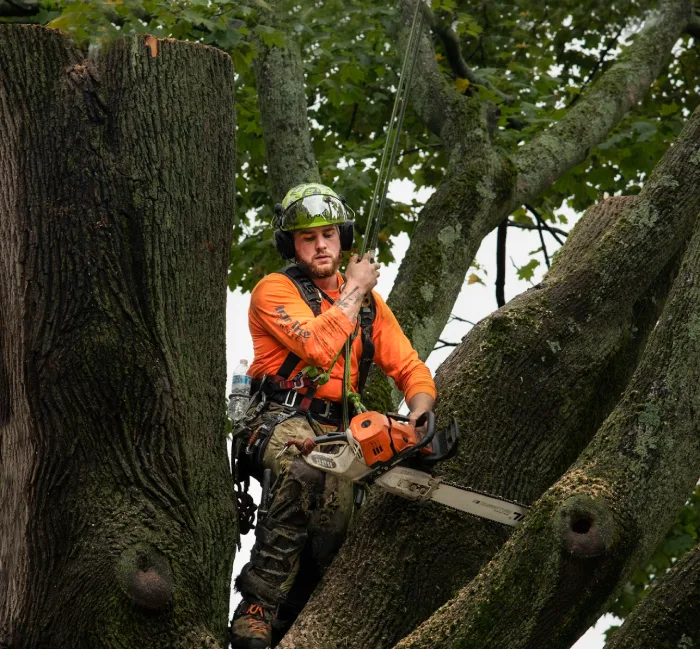
Cuts happen from the top down, either climbed or off an elevated work platform depending on the tree. Everything that comes off gets processed as we go, so the pile never builds up past what we can handle.
When we leave, the lawn is raked, the driveway is blown down and the green waste is gone. If you asked for the mulch to stay, it's stacked where you wanted it.
Why people use us
Pruning is where the qualification gap shows up most. Anyone can cut a branch off. Deciding which branch, and where the cut goes, is the part that determines whether your tree is better or worse in five years.
Our arborists hold AQF Level 5, which is the level that covers assessing a tree and writing a report on it, not just the Level 3 needed to run a saw. On a lopping job that means the person deciding what comes off is qualified to make that call.
We'll also tell you when the answer is less work rather than more. A fair number of lopping enquiries turn into a deadwood and a thin, because that's what the tree actually needs, and it costs a third of what the customer was braced for.
Tree lopping across Brisbane
We work the northern and eastern suburbs, and the lopping mix changes noticeably between them. North of the river, through Aspley, Chermside, Carseldine and Bracken Ridge, most of the work is reduction and deadwooding on the eucalypts that were left standing when those estates were subdivided. East, through Bulimba, Hawthorne, Balmoral and Norman Park, it's poincianas, mangoes and figs in older gardens on smaller blocks, which means more rigging and less felling.
Every suburb we cover has its own dedicated page with local detail, including the tree species we commonly see in that area and the access challenges associated with its housing stock. This helps us provide more informed tree lopping Brisbane services tailored to local conditions.
Send a photo and we'll price it today
Get a price for your tree
Send us a photo and your suburb. Most quotes go back the same day, and there's no obligation.
Common questions
Lopping is cutting limbs back to stubs without regard for the tree's structure. Pruning removes branches at defined points so the tree can seal the wound and keep growing properly. Almost everyone who asks for lopping actually wants pruning, and that's what we quote.
Not usually straight away, but heavy topping shortens a tree's life and makes it more dangerous. The regrowth that follows a topping cut is attached only to the outer wood, so it tears out in wind far more easily than the original limb did.
Small trees under 5 metres start from $199. Medium trees generally land between $300 and $800, and large trees between $800 and $2,000+. Anything over 15 metres or near powerlines gets quoted on site. Access and what's underneath the tree drive the price more than height alone.
Sometimes. Brisbane City Council protects certain vegetation under the Natural Assets Local Law, and individual trees can carry a Vegetation Protection Order. We check the status of your tree as part of the quote.
As a rule, no more than about 25 percent of the live canopy in a single visit on a mature tree. Younger trees tolerate a bit more. If you want a big reduction, staging it over two visits a year apart is far better for the tree.
Yes, we have accredited vegetation workers for that. Do not attempt it yourself and do not let an unaccredited contractor do it either. Depending on which line it is, Energex may be responsible for the work, and we'll tell you if that's the case.
Most residential pruning is done in half a day. A large crown reduction with difficult access and rigging can take a full day.
Yes, chipping and removal are in the quote. If you'd rather keep the mulch we'll leave it stacked wherever you want it, at no extra cost.
It depends on the species. Deadwooding should be done before storm season starts, so by October. Flowering trees like jacaranda and poinciana are best pruned after they flower. Mango goes straight after fruiting.
Yes. A single limb over a roof is a normal booking. There's no minimum job size.
$20 million public liability. A Certificate of Currency is available on request.
Quotes are usually same day or next day. For hazardous limbs we have an emergency tree removal crew on call around the clock.
Tree Lopping by Suburb Across Brisbane
We cover Brisbane's north and east for tree lopping, crown reduction and pruning. Pick your suburb for local information on common trees, council permits and typical jobs.
Other Tree Services We Offer
Get a quote
Send us a photo of the tree and your suburb and you'll usually have a price back the same day. If it's more involved than a photo can settle, we'll come out and look at it. Either way the quote is free and there's no obligation.